
Website relaunch costs depend primarily on what needs to be created and what you can carry over. This article gives you concrete price ranges and uses different site structures to explain the work behind them. That helps you plan your budget and compare proposals based on their actual scope.
How much does a website relaunch cost?
At path digital, a full B2B SaaS relaunch typically costs €40,000–€70,000 excluding VAT, with strategy included; smaller projects start at €30,000 excluding VAT. A large number of new product pages and detailed custom visuals tend to push the budget higher. Reusable templates and content that still serves its purpose help limit the workload. These figures describe our own project and pricing range, rather than an average for the German market.
A visual redesign that reuses suitable content requires less content work than a relaunch that reworks how the product is explained. Check whether a lower price assumes a smaller scope or leaves more work to your team.
Positioning and messaging establish which buyers the website should reach and which reasons to buy it should communicate. These questions need to be settled before design begins. A visual redesign alone won’t resolve unclear positioning, as we explain in our manifesto.
What scope determines your website relaunch costs?
Your website relaunch costs depend on which content and functions you can retain and what needs to be created. For each area, establish what actually needs to change and what your existing website already provides.
Positioning and messaging
Positioning and messaging require more work when several products or audiences each need their own reasons to buy. A new product or a move towards larger enterprise customers, for example, can raise different questions from your existing offer. Those questions need to be answered before they can inform the website copy.
Brand refresh
A brand refresh adds work when the underlying visual identity needs updating alongside the page layouts. This might involve revisiting the combination of colours and typefaces or setting rules for product visuals. A comprehensive rebrand or new presentation templates need to be scoped separately and are not automatically included in website relaunch costs.
Redesign
The number of distinct layouts and the work involved in developing visual content are the main factors in a redesign’s workload. A redesign can be sufficient when your positioning and messaging still fit and your existing copy continues to do its job. Product illustrations or animations become part of the work when they are needed and agreed. Pages built on shared templates require less custom design work.
Copy and translations
Writing new page copy takes more work than reusing content that still fits. The estimate therefore needs to distinguish between pages that only need editing and those that need entirely new copy; subject-matter reviews also take time. Each additional language requires translation and linguistic review. Longer versions of the copy may also require layout adjustments.
Reusable components and templates
Reusable components require additional planning and development up front because they need to work across different pages. They are configured in the content management system (CMS), the system your team uses to manage website content. Your team can then build a campaign page from existing components, for example, instead of commissioning a new layout each time. Plan templates around recurring tasks so that this work serves a clear purpose.
Integration and migration
Custom integrations and the preparation of existing content increase the work involved in a relaunch. A standard form takes less development work than a quote request journey that combines data from several systems. Migration depends on which content and functions need to be retained and how they will be transferred to the new system. The agreed migration scope belongs in the fixed-price calculation.
Checks on the migrated content and any necessary redirects also belong in the estimate. When page URLs change, Google recommends permanent redirects so that visitors and search engines can find the corresponding content.
Coordination and quality assurance
More stakeholders and additional revision rounds increase the coordination required. Testing also grows with the number of language versions or custom system connections, for example; define what needs to be checked and how many feedback rounds are included.
Your budget therefore depends on the combination of services, not just the page count. Record what can be retained and what needs to be developed so that proposals cover the same scope. Our website relaunch guide explains how these steps fit together during a project.
How does site structure affect website relaunch costs?
Ten pages using a shared template can require less design work than five individually designed pages. New copy still needs to be written for each page. Website relaunch costs therefore depend on how much custom planning is needed and what you can reuse.
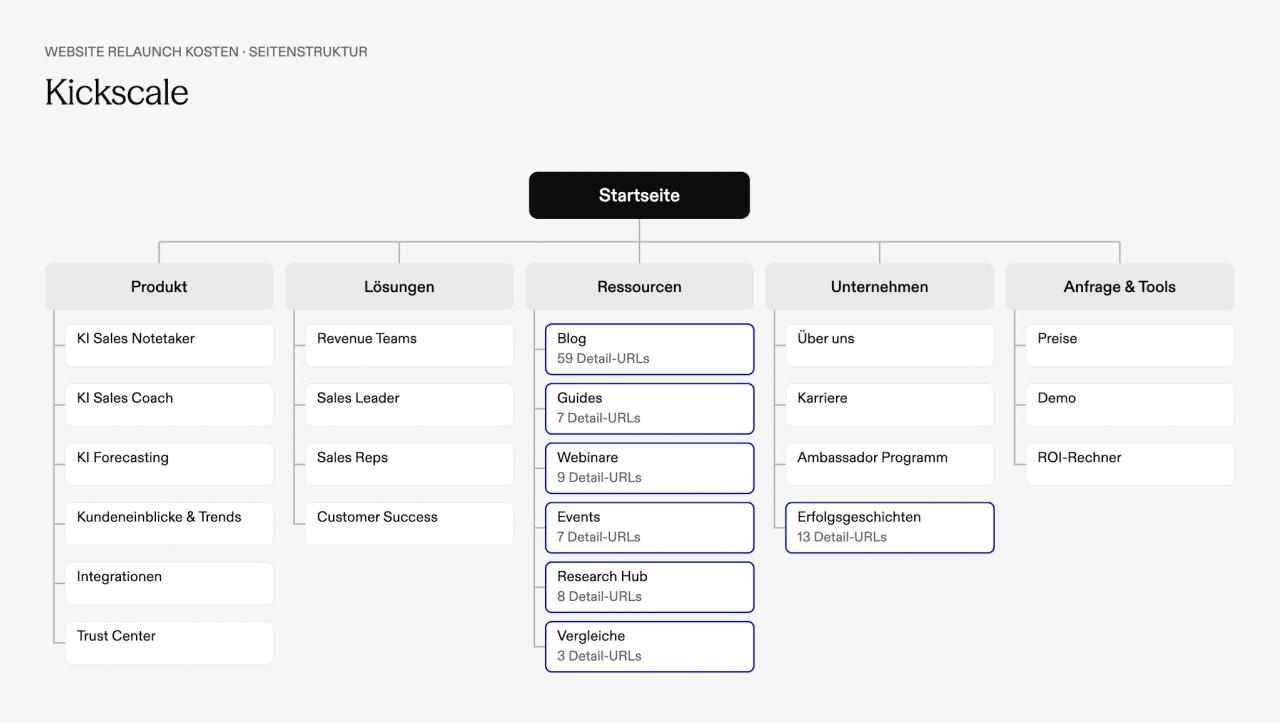
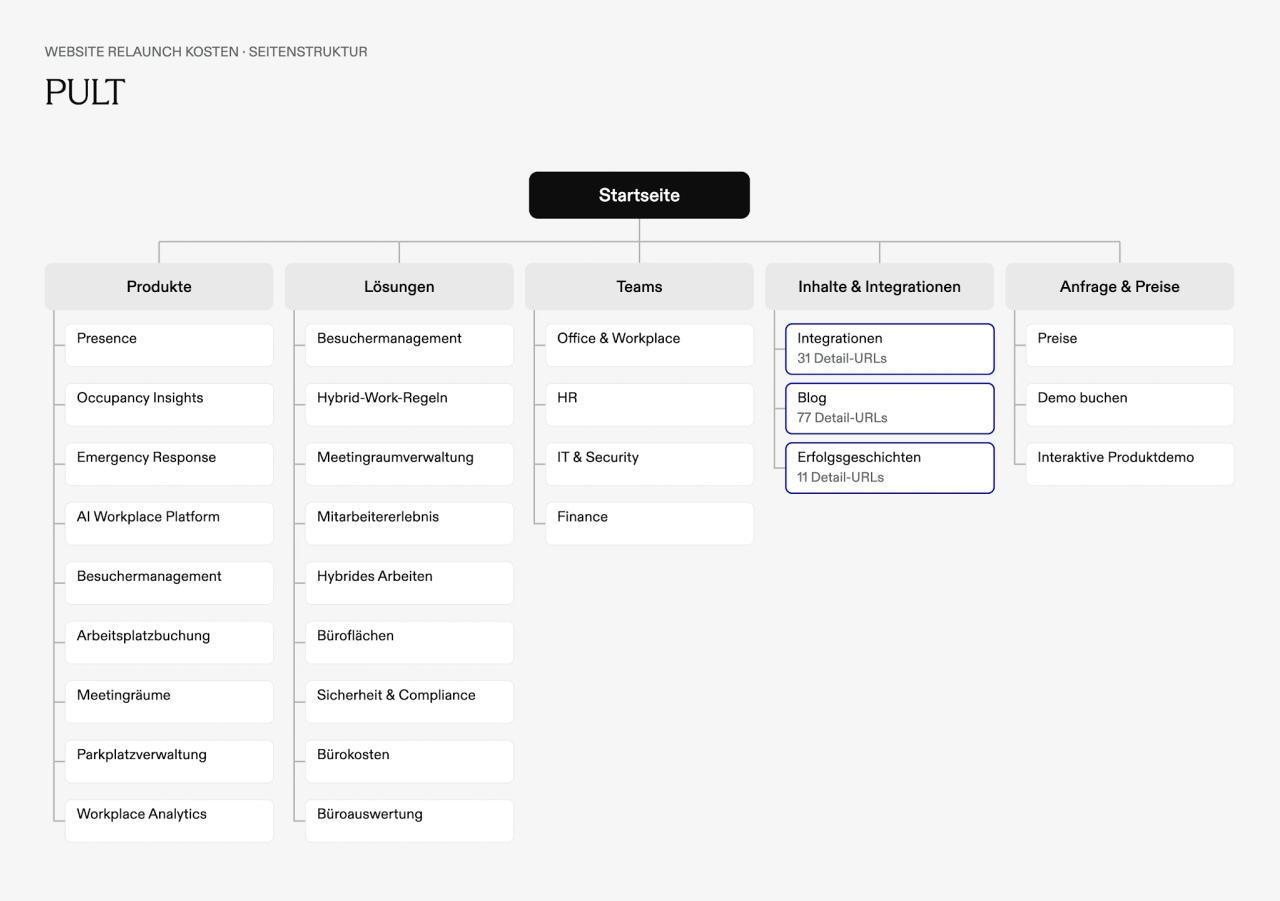
The following projects illustrate these differences across three scope scenarios. The price ranges refer to comparable work at path digital, including strategy; they are not the amounts these clients actually paid. The simplified sitemap trees show the site structure, with grouped entries representing existing content rather than the number of individually designed pages.
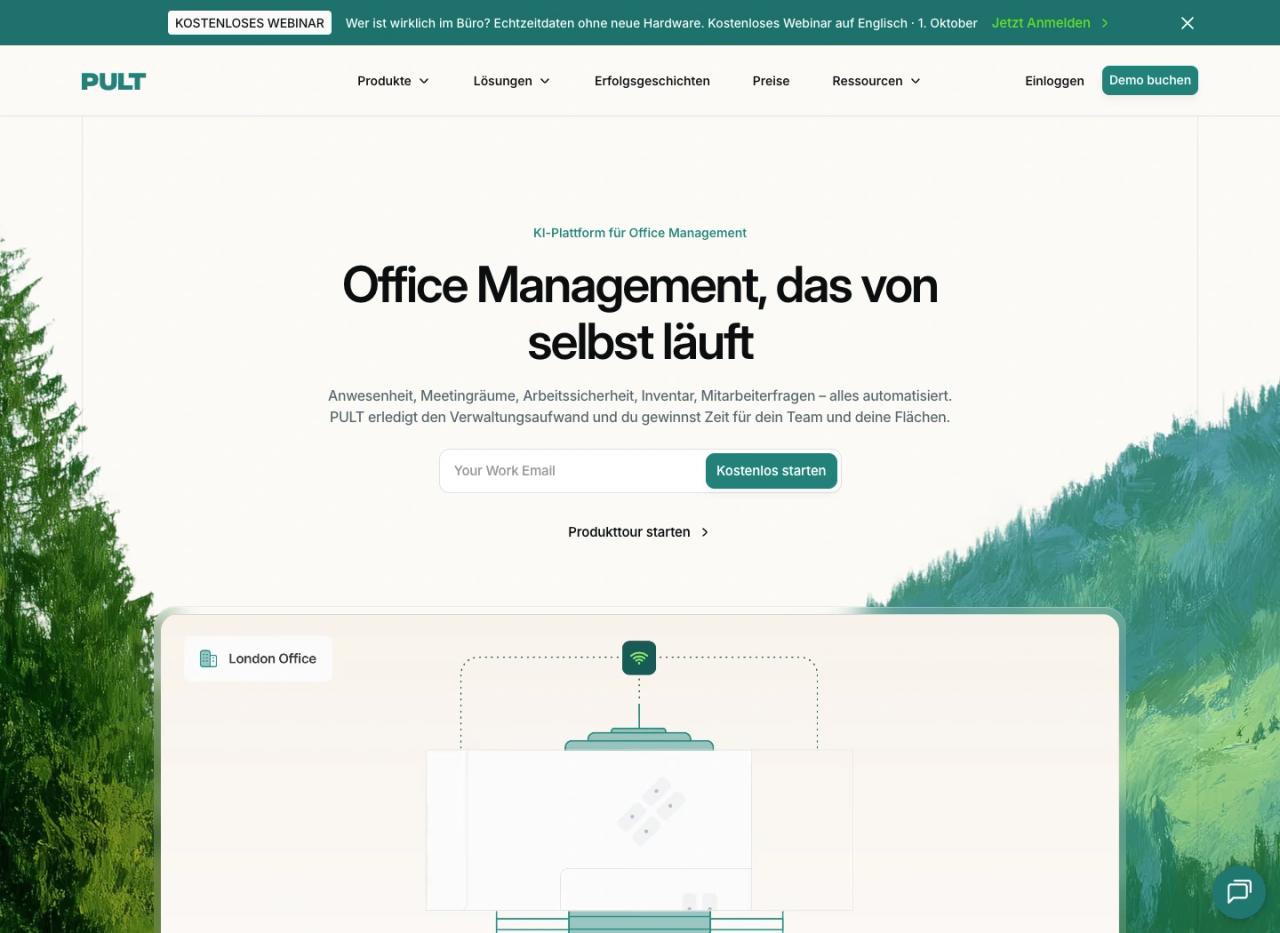
Kickscale, PULT and Converia are each available in two languages and contain numerous product illustrations adapted for both language versions. All three websites also have various integrations and connections to other systems. An estimate for a comparable relaunch therefore needs to include translating and adapting the visual content, along with implementing or migrating those connections.
A compact starting point: Kickscale
At path digital, a compact relaunch with a small number of distinct page types starts at €30,000 excluding VAT. Kickscale shows how product pages and role-specific solution pages can be complemented by resources such as guides and webinars. When these use shared templates, the number of individually designed pages stays limited. Your budget therefore depends on how many new page types are needed and which content can be added to existing structures.

Medium scope: PULT
For a comparable full B2B SaaS relaunch, our typical range of €40,000–€70,000 excluding VAT provides an initial guide. PULT combines several product areas with solution pages and a collection of integration pages. Shared templates limit design work, but distinct reasons to buy and new copy still require work on each page. Your estimate therefore needs to account for which product and solution pages must be developed from scratch.
Large scope: Converia
An extensive relaunch with many pages that need to be planned from scratch can cost towards the upper end of the €40,000–€70,000 range excluding VAT, or exceed it. Converia combines numerous feature and solution pages with a large library of blog and glossary content. Writing new product copy and creating custom visuals involve different work from migrating existing articles. Estimate new page development and content migration separately within the agreed project scope.
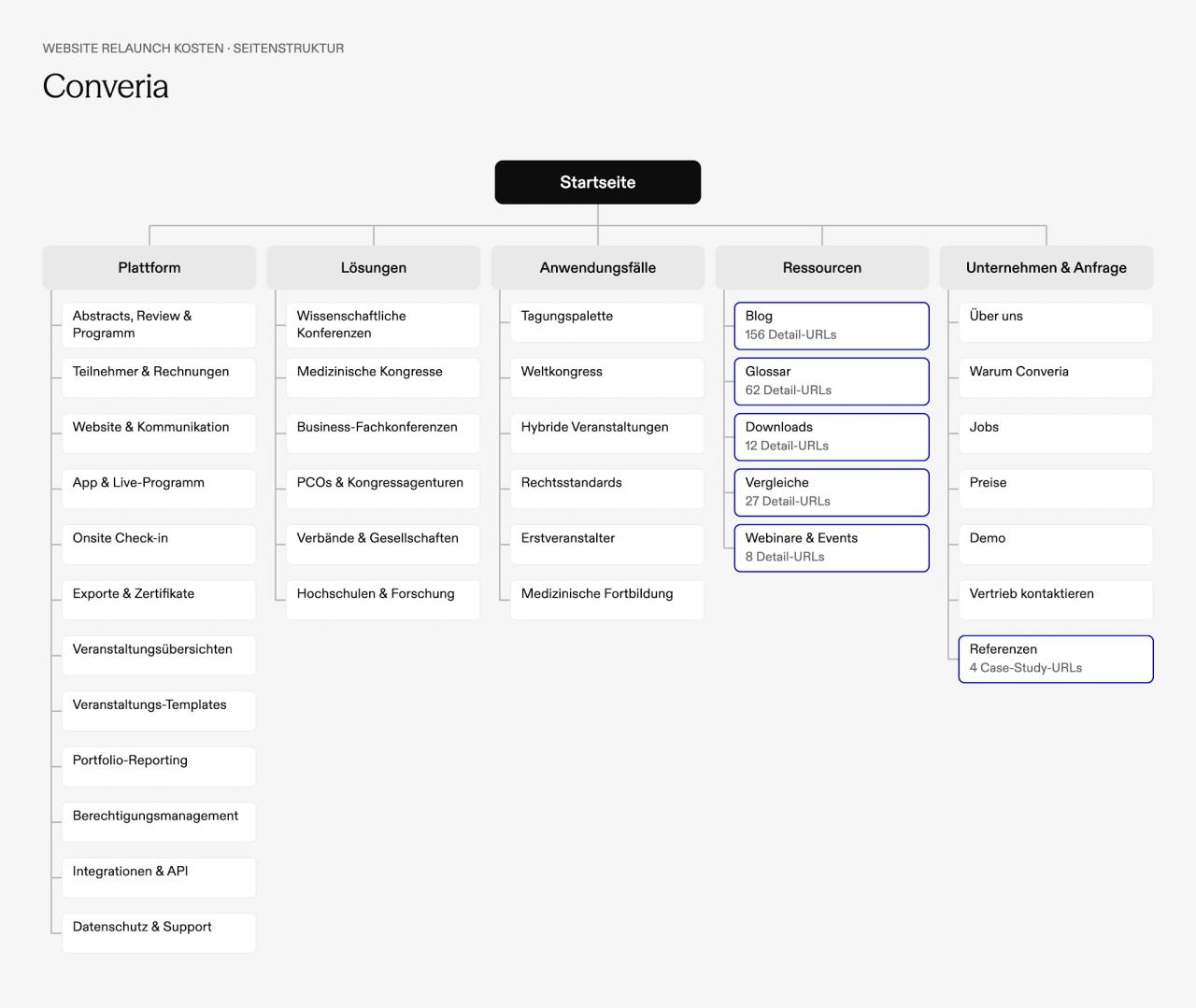
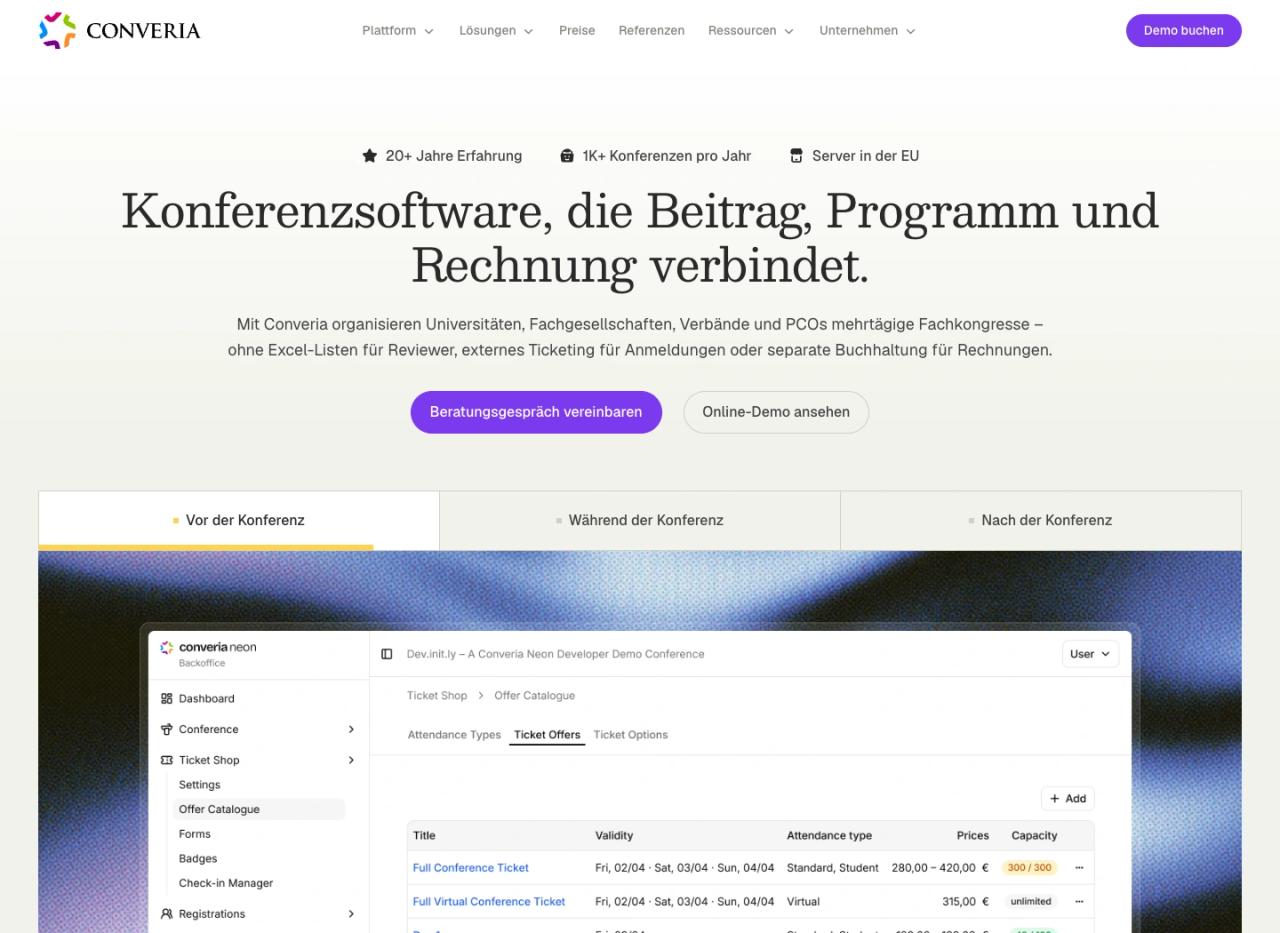
Use the site structure to identify which page types need to be created and which content can be retained. That turns a page count into a concrete scope of work you can discuss with a provider.
Which one-off and ongoing costs should you add?
Alongside the project fee, budget separately for one-off third-party costs and ongoing operations. Check which tasks your team will handle and which services are already included in the fixed price. This helps you avoid missing costs or counting them twice.
- Your team’s time: Set aside time to share product knowledge and review copy for accuracy. Preparing content and providing approvals also take up team capacity.
- Ongoing operations: Hosting and CMS fees continue after the relaunch. Depending on your setup, there may also be fees for multilingual features or other paid services.
- One-off third-party costs: Budget for any photo or video production outside the agreed scope. Check whether image and font licences carry one-off or recurring fees.
- Temporary overlap: During the transition, you may need to pay for the old and new systems at the same time.
- A reserve for specific additions: If another language version is already likely, for example, request a separate estimate and set aside that amount if needed. Work already covered by the fixed price does not need a second budget line.
Your team’s involvement does not automatically create an additional invoice. It does, however, take time away from other work. Show the estimated value of that time separately from external spending.
After launch, the website needs ongoing development, for example when you add products or need dedicated campaign pages. Plan available working time for this alongside operating costs. This ongoing work is separate from completing the agreed relaunch.
Your internal team can handle these tasks, or an agency can support them through an ongoing arrangement. A retainer provides agreed services or capacity on a regular basis for a monthly fee. Whether it makes sense depends on how often new tasks arise and which skills you have in-house.
How can you reduce website relaunch costs?
You can reduce the initial investment by launching important pages first and adding other areas later; this does not automatically reduce the total cost. Your positioning and reusable templates should be in place from the start. Later additions can then build on the same foundation.
An initial version might consist of the homepage and the most important product or use-case pages. Buyers need to understand whether the offer solves their problem and why it suits them. The next step, such as requesting a demo, also needs to be clear.
Retain brand elements and copy that still fit, and check which existing components you can keep using. Elaborate animations or lower-priority features are easier to postpone than necessary redirects. A working enquiry route also belongs in the initial version.
Contributions from your team can reduce the external fee if you have the necessary skills and available time. Have the proposal specify which agency tasks this removes, and account for the capacity it takes up internally. If the problem affects only one page, improving that page may allow you to postpone a full relaunch.
How do you compare website relaunch proposals?
Two final prices are only comparable when the included services and your team’s responsibilities are comparable too. Check the concrete outcome each provider will deliver and what you need to prepare yourself. The following checklist helps you clarify open questions before commissioning the work.
| Question to check | What to look for in the proposal |
|---|---|
Are positioning, messaging and finished copy included? | Who develops the positioning and core messages; separately, who delivers the finished copy for each page |
Which pages will be created? | The distinction between individually planned pages, templates and content migration |
What will be retained from the existing website? | Content, languages, redirects and technical requirements |
Which integrations are agreed? | Which systems will be connected, and what integration and testing work is included |
How will feedback and changes be handled? | Included revision rounds, approvals and the process for additional scope |
What happens at launch and afterwards? | Testing, training, handover and clearly defined support |
Which costs are additional? | Third-party costs, licences, ongoing services and separately commissioned work |
Put these points into the same comparison sheet for each proposal and mark any unanswered questions. If one provider expects finished copy and another writes it, your overall calculation needs to account for that difference. Otherwise, you are comparing different services by their final price alone.
Fixed price or time and materials?
A fixed price suits a clearly defined scope and makes budget planning easier. If the technical feasibility of a custom integration is still uncertain, a limited investigation billed on a time-and-materials basis may make sense. Agree a spending cap and check usage at set intervals. Additional work should only begin after your approval.
Before commissioning the work, record how many feedback and revision rounds are included in each phase. Clarify this for strategy as well as copy and design. If an already approved design direction needs to be reworked, for example, agree the scope and price of that additional work before it begins.
What information do you need for a concrete cost estimate?
You don’t need a finished brief to get an initial cost estimate. Your current website and a short description of the change you want are enough to start the conversation. Any scope details you already know help narrow the estimate.
- Starting point: Your website URL and the problem the relaunch should solve.
- Planned website: Which products and audiences should it cover? Which pages do you have in mind?
- Content: What can be retained, what needs to be created and which languages are required?
- Technology: Your existing CMS, relevant forms and connected systems.
- Constraints: Your preferred launch date and any known budget limit. How much time can your team set aside to contribute?
If the number of new pages to write or language versions is still undecided, mention that in your enquiry. An initial estimate of website relaunch costs provides a guide, while a binding fixed price requires an agreed scope of work. If your budget is fixed, this helps establish which pages and functions to implement first.