


The new Webflow website has been live since 25 September 2026. Comparable before-and-after data on enquiries and demo bookings is not yet available.
Conference software for the processes behind the event
Converia develops software for multi-day, content-driven conferences. Universities, professional societies, associations and professional conference organisers use it when they need to review submissions, plan parallel programmes, register participants and issue accurate invoices.
Two product lines. Three websites. One brand that needed to connect them.
Before the relaunch, the older Converia website sat alongside neon.converia.de. The blog ran separately on blog.converia.de in WordPress. The websites used different systems and did not tell a shared product story. Buyers encountering the brand for the first time had to work out how Converia and Neon were connected and why the software offered more than a ticketing tool.
This was a sales problem. Converia wanted to reach the people organising complex academic and professional conferences. Yet, according to the positioning workshop, enquiries also came in for much simpler events. The website lacked a quick answer to the question: what connects this software across the entire conference process?
Deciding on the story before deciding on the design
The new website needed to bring the Converia and Neon product lines together under a refreshed brand. The team can discuss which product generation suits a customer in a conversation. Before that conversation, the website needed to show which conferences Converia is built for and why its individual features become valuable when they work together.
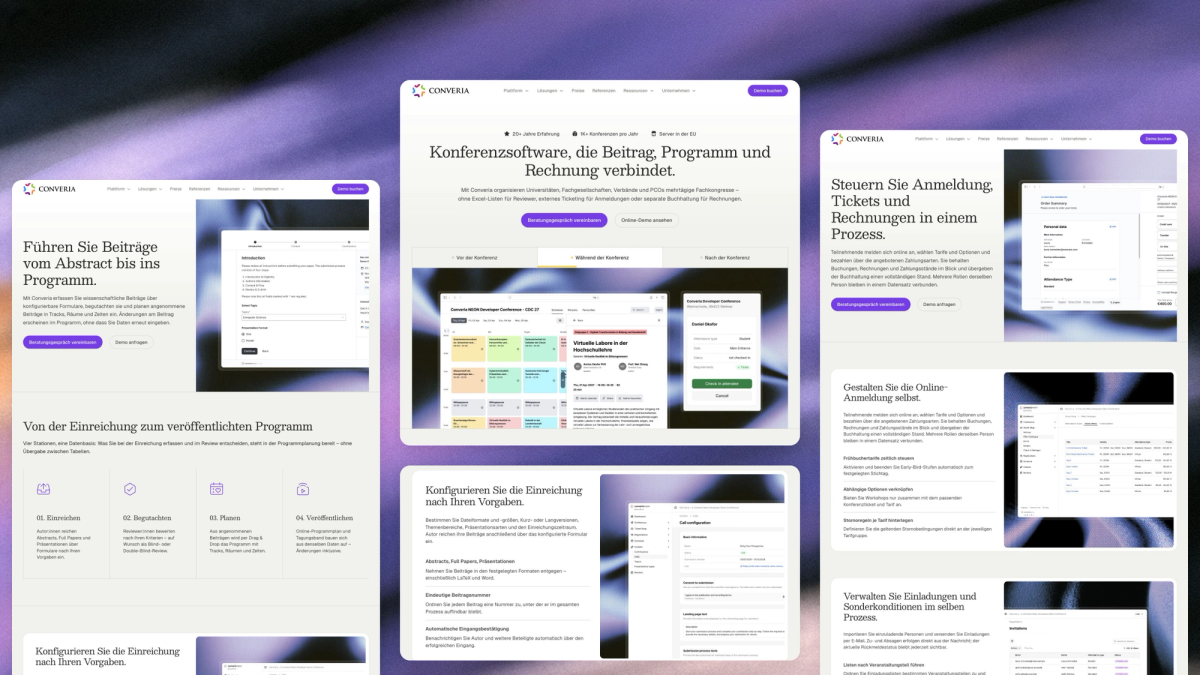
In the positioning workshop, we therefore focused on multi-day conferences with complex programmes. This led to a site structure that connects product features, audiences and specific use cases. It guides visitors from their initial problem to the right solution, rather than leaving them to make sense of a long feature list.

The conference process became the structure of the website
Putting the product in context
We identified what separates a content-driven conference from a simple event: submissions and reviews, parallel sessions, participant roles, registration and billing. This distinction gave the messaging a clear direction.
Writing for different buying contexts
Universities, professional societies and professional conference organisers assess software for different reasons. The new structure gives each audience its own starting point and explains how Converia fits their processes. Product pages show features in the context of the conference process.
Refreshing the brand
The brand refresh brought the logo, typography, colours and visuals into a consistent identity. Simplified visuals explain workflows that a single product screenshot can rarely make clear.
Bringing two product lines together on one website
We designed and built the new Webflow website for Converia and Neon. Feature, solution and use case pages give both product generations a shared language, without reducing the buying decision to a technical product choice.
Migrating the blog from WordPress to Webflow
The existing articles lived on blog.converia.de. We moved them into the Webflow CMS and rebuilt the custom WordPress formats they needed: callout boxes and download elements as reusable Webflow components, tables as responsive embeds, and images and videos in suitable Webflow formats. This kept the content readable and editable, rather than leaving broken shortcodes in the articles.
Launching the website
The German and English website went live on 25 September 2026. Work on cleaning up old blog URLs and other technical follow-up tasks continued after launch.
The result is visible. The business impact is still being measured.
The new homepage now states the core of the product directly: conference software that connects submissions, programmes and invoices. Below that, it takes visitors through the stages before, during and after a conference. Dedicated feature and solution pages explore the questions that universities, associations and professional conference organisers need answered.
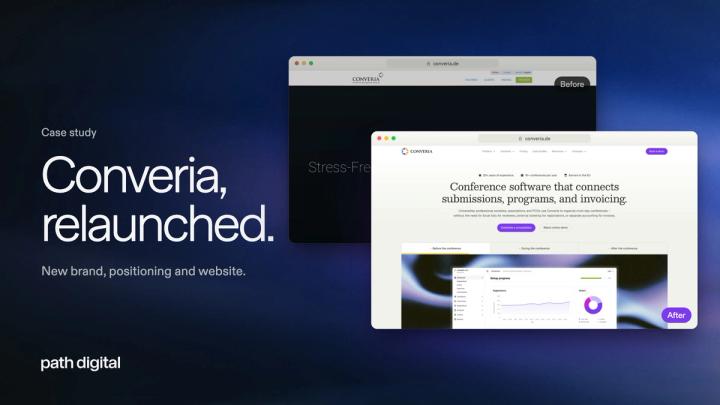
This is a verifiable result of the relaunch: two product lines now share one website and a refreshed brand. The previously separate WordPress blog is integrated into Webflow as a content section. Visitors can now understand the breadth of the software and who it serves through one coherent website. Whether this generates more relevant enquiries, demo bookings or sales opportunities cannot yet be substantiated after launch.
Does this sound familiar?
You have more than one product, an established content library or several websites for an offering that belongs together. It makes sense to your team. New buyers have to work out the connections for themselves.
If your website attracts enquiries for the wrong use case, it is worth looking at the story it tells first. Which buyers should recognise themselves in it? Which processes do they need to understand? And which content helps them decide?
